Listen to the hymn:
This is my own recording of O Come, O Come, Emmanuel with my Catholic project, Cassia & Myrrh. You can download a free Gregorian chant catalogue here.
O come, O come, Emmanuel,
And ransom captive Israel…
O Come, O Come, Emmanuel is one of the oldest and most beloved hymns in the Christian tradition, especially for Christmas. While it is often included in Christmas collections and concerts, it is first and foremost an Advent hymn—a hymn of expectation, longing, and hope as the Church prepares to celebrate the birth of Christ.
Unlike many familiar Christmas carols, it does not begin at Bethlehem. There are no shepherds, angels, or manger scene. Instead, it gives voice to the centuries of waiting that came before the Nativity, recalling God’s promises to Israel and the longing for the Messiah who would finally come to redeem His people.
That distinctive perspective is one reason the hymn has remained so enduring, as well as its roots in the ancient beauty of Gregorian chant. Rather than celebrating an event that has already taken place, it invites us to enter into the anticipation that preceded it. In doing so, it reminds us that Christmas did not begin in Bethlehem alone. It began centuries earlier with God’s promises to His people, promises that Christians believe were fulfilled in the coming of Jesus Christ.
The hymn is also remarkable for its history. Its roots reach back well over a thousand years, drawing on some of the Church’s oldest prayers and weaving together a rich tapestry of biblical prophecy, ancient liturgy, and Christian hope. The familiar English version sung today is only one chapter in a much longer story—one that stretches from medieval monasteries to churches throughout the world.
Whether you have come looking for the lyrics, the meaning of the hymn, the history of Veni, Veni, Emmanuel, or an explanation of the ancient O Antiphons from which it developed, this guide explores the origins and enduring significance of one of Christianity’s greatest Advent hymns.
What Does O Come, O Come, Emmanuel Mean?
At its heart, O Come, O Come, Emmanuel is a prayer.
The hymn expresses the longing of God’s people for the coming of the promised Messiah, drawing on the language of the Old Testament and the prophecies that Christians believe were fulfilled in Jesus Christ. Every verse is an invitation for the Savior to come and bring His people the redemption, wisdom, freedom, and peace that only He can give.
The opening line, “O come, O come, Emmanuel,” immediately introduces one of the Bible’s most important names for Christ.
Emmanuel means “God with us.” The name comes from the prophecy of Isaiah:
“Behold, the virgin shall conceive and bear a son, and shall call his name Immanuel.” (Isaiah 7:14)
Christians understand this prophecy to be fulfilled in the birth of Jesus, whose coming is described in the Gospel of Matthew using the same title:
“They shall call his name Emmanuel” (which means, God with us). (Matthew 1:23)
That single word captures the heart of Christmas. In Jesus Christ, God did not remain distant from humanity but entered the world, taking on human flesh and dwelling among His people.
The hymn also speaks of Israel as “captive.” While those words recall the historical exile of the Jewish people, they point beyond a single moment in history. Christian tradition has long understood them as expressing humanity’s deeper longing for redemption from sin and separation from God.
As the hymn continues, each verse addresses Christ under a different biblical title. He is called Wisdom, the Root of Jesse, the Key of David, the Dayspring, the King of Nations, and finally Emmanuel. Each title comes from Scripture and highlights a different aspect of Christ’s identity and mission.
Together, these verses present a remarkably rich portrait of the Messiah. Rather than simply celebrating His birth, they proclaim who He is and why His coming matters.
The familiar refrain brings the prayer to its joyful conclusion:
Rejoice! Rejoice! Emmanuel
Shall come to thee, O Israel.
Even here, however, the hymn retains its Advent character. It is a song of confident hope rather than completed celebration. The promise has been given, and the Church waits in joyful expectation for its fulfillment.
That spirit of expectation is one reason O Come, O Come, Emmanuel has remained one of the defining hymns of Advent for centuries. Before Christmas arrives with its songs of rejoicing, this hymn invites Christians to remember the long story of hope that made Christmas possible.
The O Antiphons: The Ancient Prayers Behind the Hymn
One of the reasons O Come, O Come, Emmanuel has such remarkable depth is that it did not begin as a hymn at all.
Its roots lie in a series of ancient prayers known as the O Antiphons, which have been part of the Church’s liturgy for well over a thousand years. These short prayers are traditionally sung before the Magnificat in honor of Mary during Evening Prayer (Vespers) from December 17 through December 23, marking the final week of Advent as the Church prepares for Christmas.
Each antiphon begins with the word “O” and invokes Christ by one of the great biblical titles found in the Old Testament. Together, they form a beautiful meditation on the identity of the promised Messiah.
The traditional titles are:
- O Sapientia — O Wisdom
- O Adonai — O Lord
- O Radix Jesse — O Root of Jesse
- O Clavis David — O Key of David
- O Oriens — O Dayspring
- O Rex Gentium — O King of the Nations
- O Emmanuel — O God With Us
| O Antiphon (Latin) | English Title | Principal Scripture | What It Reveals About Christ |
|---|---|---|---|
| O Sapientia | O Wisdom | Proverbs 8; Wisdom 8:1; Isaiah 11:2–3 | Christ as the eternal Wisdom of God, who orders all creation and guides His people. |
| O Adonai | O Lord | Exodus 3:1–15; Isaiah 11:4–5 | Christ as the Lord who revealed Himself to Moses and fulfills God’s covenant with Israel. |
| O Radix Jesse | O Root of Jesse | Isaiah 11:1–10 | Christ as the promised descendant of Jesse and David, the long-awaited Messiah. |
| O Clavis David | O Key of David | Isaiah 22:22; Revelation 3:7 | Christ who opens the Kingdom of Heaven and frees those held in darkness and sin. |
| O Oriens | O Dayspring (Morning Star) | Isaiah 9:2; Malachi 4:2; Luke 1:78–79 | Christ as the true Light who dispels darkness and brings hope to the world. |
| O Rex Gentium | O King of the Nations | Isaiah 9:6–7; Haggai 2:7 | Christ as the universal King who gathers all peoples into His kingdom. |
| O Emmanuel | O God With Us | Isaiah 7:14; Matthew 1:23 | Christ as God dwelling among His people in the mystery of the Incarnation. |
Each title comes from Scripture and highlights a different aspect of Christ’s mission.
Wisdom recalls the eternal Wisdom of God through whom all things were made.
Root of Jesse points to Christ as the promised descendant of King David foretold by the prophet Isaiah.
Key of David speaks of His authority to open the Kingdom of God and set His people free.
Dayspring (sometimes translated Morning Star or Rising Dawn) celebrates Christ as the Light who dispels darkness.
King of the Nations proclaims Him as the universal King who comes not only for Israel but for all peoples.
Finally, Emmanuel brings the sequence to its fulfillment: God Himself has come to dwell with His people.
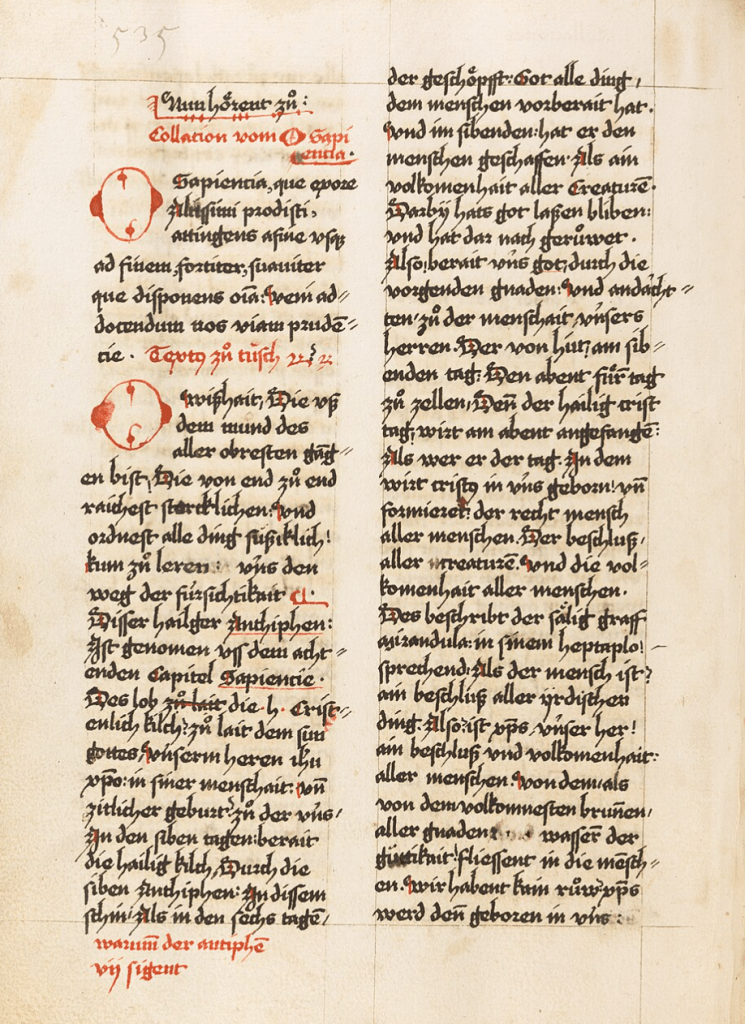
The verses of O Come, O Come, Emmanuel draw directly from these ancient prayers. Each verse takes one of the biblical titles, reflects on its meaning, and asks Christ to come.
This explains why the hymn feels different from many familiar Christmas carols. Rather than telling the story of the Nativity, it is built from Scripture and prayer. Each verse becomes a meditation on one of the Church’s oldest Advent themes, inviting Christians to remember the promises of God before celebrating their fulfillment at Christmas.
There is another beautiful detail hidden within the O Antiphons. When the first letters of the Latin titles are read in reverse order—Emmanuel, Rex, Oriens, Clavis, Radix, Adonai, Sapientia—they form the acrostic ERO CRAS, which means “Tomorrow I will come.”
Whether intended as a literary flourish or simply preserved by tradition, it is a fitting conclusion to the Church’s final days of Advent. After centuries of waiting and seven days of prayer, the answer arrives: Tomorrow I will come.
History of O Come, O Come, Emmanuel
Although O Come, O Come, Emmanuel is now one of the world’s best-known Advent hymns, its history stretches back many centuries.
The hymn is based on the medieval Latin text Veni, Veni, Emmanuel, which developed from the much older O Antiphons discussed above. Those antiphons had already been part of the Church’s Advent liturgy for centuries before they were brought together into a single hymn.
The exact origins of the Latin hymn are difficult to pinpoint. Scholars generally trace it to the medieval Church, with manuscripts appearing several hundred years ago. By that time, Christians throughout Europe were already praying the O Antiphons during the final days of Advent, making the hymn a natural extension of an established liturgical tradition.
The English version familiar today did not appear until the nineteenth century. It is most closely associated with the Anglican priest and hymn translator John Mason Neale, whose work introduced many ancient Latin hymns to English-speaking congregations. His translation helped preserve both the biblical richness and the reverent character of the original text while making it accessible to a much wider audience.
The melody most commonly paired with the hymn is also of medieval origin. Its quiet, modal character gives O Come, O Come, Emmanuel a distinctive sound that sets it apart from many later Christmas carols. Rather than emphasizing celebration, the melody reflects the spirit of Advent itself—a season marked by hope, expectation, and preparation.
Today the hymn is sung by Christians around the world, including Catholics, Orthodox, Anglicans, Lutherans, and many Protestant communities. Few hymns are shared so widely across Christian traditions, a testament both to its ancient roots and to the timeless themes it expresses.
More than a thousand years after the O Antiphons first entered the Church’s liturgy, O Come, O Come, Emmanuel continues to connect modern Christians with that same tradition of prayer. Each Advent, it invites a new generation to reflect on God’s promises, prepare for the celebration of Christ’s birth, and look forward in hope to His coming again.
Why O Come, O Come, Emmanuel Is Sung During Advent
Unlike many Christmas carols, O Come, O Come, Emmanuel is intended to be sung before Christmas Day.
Advent is the season in which Christians prepare for the celebration of Christ’s birth. During these weeks, the Church remembers not only the events leading up to the Nativity but also the centuries of expectation that came before it. The prophets foretold the coming of the Messiah, and generation after generation waited for the fulfillment of God’s promises.
This hymn gives voice to that waiting.
Rather than beginning with the shepherds at Bethlehem or the angels announcing Christ’s birth, it remains in the time of promise. Every verse expresses humanity’s longing for the Savior, asking Him to come and bring wisdom, freedom, justice, light, and peace.
That perspective makes the hymn especially appropriate during Advent. Before Christians celebrate that Christ has come, they first remember why His coming mattered.
The hymn also carries a second meaning for Christians today. While Jesus has already entered history through His birth, death, and Resurrection, the Church continues to await His return in glory. For that reason, Advent has always looked in two directions at once: back to the first coming of Christ at Bethlehem, and forward to His promised return at the end of time.
O Come, O Come, Emmanuel reflects both of these realities. It remembers the longing of ancient Israel while also becoming the prayer of the Church in every generation.
That is one reason the hymn has endured for so many centuries. Its words are rooted in Scripture, shaped by the Church’s ancient liturgy, and centered on the hope that God keeps His promises. Whether sung in a monastery, a cathedral, a parish church, or a family home, it continues to prepare hearts for the celebration of Christmas.
Conclusion
For more than a thousand years, O Come, O Come, Emmanuel has remained one of the Church’s great Advent hymns. Its ancient origins, rich biblical imagery, and connection to the O Antiphons have given it a unique place within the Christian tradition.
As Christmas approaches each year, the hymn reminds us that the celebration of Christ’s birth is the fulfillment of a much longer story—the story of God’s promises to His people and their hope in the coming of the Savior.
If you are looking for a traditional recording of this beautiful hymn, I hope my performance helps you enter more deeply into the prayer and expectation that have made O Come, O Come, Emmanuel such a treasured part of Advent for centuries.
FAQs
Frequently Asked Questions
What does “Emmanuel” mean?
The name Emmanuel means “God with us.” It comes from the prophecy of Isaiah (Isaiah 7:14) and is applied to Jesus in the Gospel of Matthew (Matthew 1:23), expressing the Christian belief that God became man in the person of Jesus Christ.
Is O Come, O Come, Emmanuel a Christmas carol or an Advent hymn?
Although it is often included in Christmas concerts and recordings, O Come, O Come, Emmanuel is traditionally an Advent hymn. It is sung during the weeks leading up to Christmas, expressing the longing and hope that preceded Christ’s birth.
What are the O Antiphons?
The O Antiphons are seven ancient prayers sung during Evening Prayer (Vespers) from December 17 through December 23. Each addresses Christ by a different biblical title—such as Wisdom, Key of David, Dayspring, and Emmanuel—and asks Him to come. The verses of O Come, O Come, Emmanuel are based on these prayers.
Who wrote O Come, O Come, Emmanuel?
The hymn developed from the medieval Latin hymn Veni, Veni, Emmanuel, which itself was inspired by the ancient O Antiphons. The best-known English translation is associated with John Mason Neale, who introduced many historic Latin hymns to English-speaking Christians during the nineteenth century.
Why is the hymn also called Veni, Veni, Emmanuel?
Veni, Veni, Emmanuel is simply the Latin title of the hymn. The English version, O Come, O Come, Emmanuel, is a translation of the opening line.
Why is this hymn so important during Advent?
The hymn captures the central theme of Advent: waiting in hope for the coming of the Messiah. Rather than celebrating Christ’s birth after it has taken place, it gives voice to the prayers and expectations of God’s people before Christmas, helping Christians prepare spiritually for the celebration of the Nativity.

