What Is Gregorian Chant? History, Meaning, and Why It Still Matters
If you’ve spent any time around the Catholic Church, especially in older liturgical settings and monasteries, you’ve heard Gregorian chant, even if you didn’t know what to call it.
It doesn’t sound like most music: it’s slower and unaccompanied. There’s no beat to follow in the usual sense. And yet it has endured for over a thousand years, gently but persistently forming the backdrop of Christian prayer across the centuries.
This is not incidental but instead an expression of divine providence, the needs of the human heart in the “valley of tears” we all find ourselves in, and the remedies that can re-align us with peace of soul.
Listen to a simple example of Gregorian chant:
This is a sample from my full catalogue of Gregorian chant with PDF guide, which you can have for free at the end of this article.
What Gregorian Chant Is
Gregorian chant is the traditional sacred music of the Western Church, named (somewhat loosely) after Pope Gregory I. It developed over centuries, drawing from earlier Jewish and early Christian forms of sung prayer.
At its core, chant is simple:
- one melodic line (no harmony)
- sung in Latin
- closely tied to the structure of the liturgy
It’s not written to entertain, but to peacefully carry the true heart and spirit of ancient prayer and the richness of a long-standing tradition.
That distinction matters a lot, as the music follows the words, and not the other way around. It doesn’t need to compete for our attention, but instead invites the listener in to a sacred place where the soul can be transformed.
Why It Sounds the Way It Does
Chant doesn’t have a strict, driving rhythm because it’s built around speech—specifically, the natural cadence of Latin.
The result is something that feels suspended, and “above the fray.” It is pointing to an eternal world beyond the confines of our structures and ideas.
There’s no urgency or sense of pushing to it. The music rises and falls with the text itself, which is why even people unfamiliar with Latin often sense its meaning anyway. Intuitively, every person grasps that this is something different, unassuming, but commanding in its elevated beauty and simplicity.
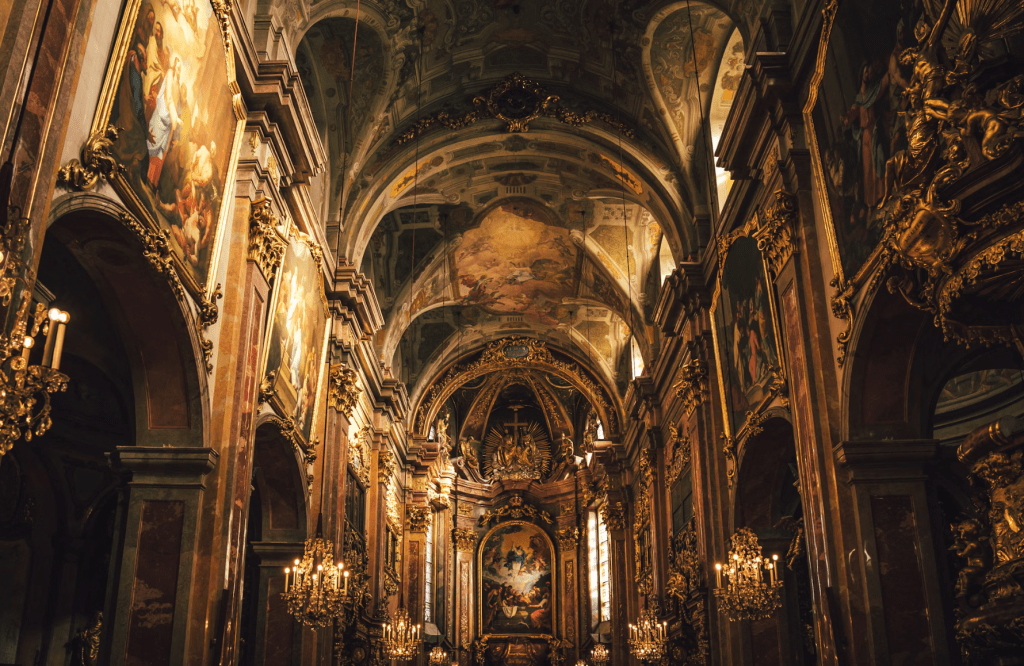
Part of its purpose is to create the kind of space sonically that we find in a cathedral dome, with the similar goal of bringing us beyond our limited, finite scope as humans into the perspective of God.
The point is not at all emotional intensity in the modern sense, but a peaceful clarity bringing light, meaning, depth, and hope to our experience of life, calling us into communion with the Divine.
Chant and the Mass
Gregorian chant isn’t just a style, but something unique that is embedded in the structure of the Mass and various liturgical and monastic contexts.
Certain parts of the liturgy are often sung in chant (universally in the Extraordinary Form and still commonly in varying degrees in the Ordinary Form).
- Kyrie (Lord, have mercy)
- Gloria (Glory to God in the highest)
- Credo (the profession of faith)
- Sanctus (Holy, Holy, Holy)
- Agnus Dei (Lamb of God)
These are called the Ordinary of the Mass, or, in more common language, texts that remain consistent across time.
Other chants change daily or seasonally, and are often found in various forms in English (or the vernacular) in the Ordinary Form:
- Introit
- Gradual
- Offertory
- Communion
These form the Proper of the Mass, tied to the liturgical calendar.
Understanding that framework helps make sense of individual chants. They’re not isolated pieces, but exist in a much larger context where they can be grasped within the whole.
Chant as Prayer (Not Performance)
One of the reasons chant can feel unfamiliar today is that it absolutely resists performance, receding instead into a shared communal sense of prayer across time. It is not about the individual voice (developed heavy vibrato, for example, is not well-suited to the form but rather a more natural, blending voice). It truly is about humbly stepping inside of a tradition that belongs to everyone.
Ideally, there is no spotlight or soloist in the modern sense. Even when sung beautifully, it doesn’t draw attention to itself, and this is intentional.
The goal is not to impress, but to direct attention elsewhere: toward the text, toward prayer, toward God.
In a way, chant feels closer to an interior silence, adjacent to the almost-imperceptible movements of the heart.
Why It Has Lasted
Gregorian chant has survived not because it adapts easily, but precisely because it doesn’t.
Its unchanging stability is its core attraction, especially in a world that is loud and fragmented and constantly vying for our attention through screens and intense opinions. It promises something completely other from the world as it is, and it refuses to force itself into our lives, instead quietly inviting us into a slow, peaceful experience of the Divine of our inner world which can so easily be drowned out by the noise.
People return to chant because it offers something they’re not finding elsewhere: a different pace, orientation, and kind of attention. A person does not need to immediately understand it, and in fact, the initial strangeness of it as a contrasted sound is part of why it is so compelling. Nothing else it like it.
How to Begin Listening
If you’re new to Gregorian chant, the best approach is simple: don’t analyze it right away or feel you have to understand everything all at once. Simply let it wash over you and bring you the peace, comfort, and grace you are so hungry for. Let yourself be aware of your need for something beyond the hyperstimulation of the world.
Start with familiar texts:
- Ave Maria
- Pater Noster
- Salve Regina
Follow along with the translation if you can. Notice how the melody moves with the words.
That’s enough to start. As you become familiar, you can work your way through the online catalogue on the site here, or download the entire catalogue with PDF guide at the end of this page.
A Living Tradition
Gregorian chant isn’t just historical but something that persists and is living.
It’s still used consistently in monasteries, parishes, and communities around the world, and in recent years is having a significant revival as many people recognize their deep need for something beautiful, lasting, and different from their daily lives.
It continues to do what it was always meant to do: carry prayer to weary hearts, communicating the deep meaning of the words bequeathed to us over time from a God who loves us and is constantly seeking us out.
Once you begin to hear it that way, it stops sounding distant and becomes an immediate balm and process of formation of the affection and interior life toward God.
It becomes very direct and even very practical, giving us what we most need and shaping us into who we are truly meant to be.
If you’d like to go further, I’ve recorded a collection of these chants in their traditional forms.
You can listen to and download the full album here:
These recordings are offered freely.
If you find them helpful, you’re welcome to stay connected—there’s more coming.
Listen and Download the Full Chant Album
If you’d like to hear these chants in full, I’ve recorded a complete collection using the traditional texts and melodies.
You can listen to the entire album and download it for free here:
 Catholic Kind: Catholic Music & Culture Resource