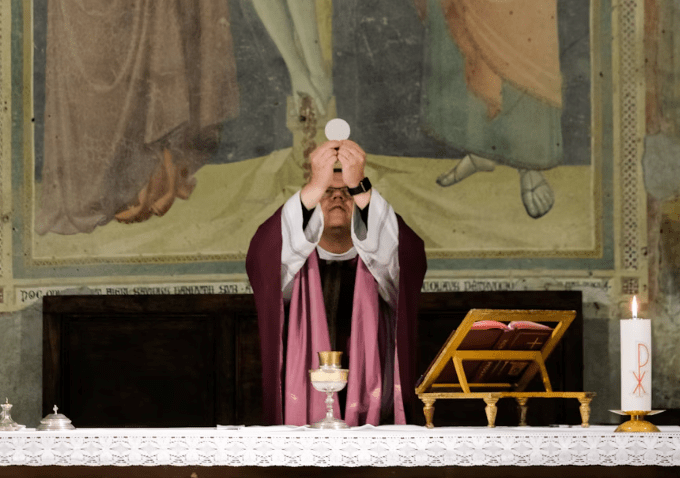
The Sanctus is one of the clearest moments of praise in the Mass. It doesn’t ask for or explain anything, but simply declares something that is already true, rooted in the history and Scripture that has been referenced throughout all of Christian history.
This Missa de Angelis Gregorian chant setting is more complex than the somewhat more familiar Jubilate Deo version, containing a more joyful and lifted sound but remaining still singable and accessible by most people. Even without prior knowledge, it has a kind of familiar, peaceful quality many would describe as a spiritual homecoming.
This is a common experience with Gregorian chant.
Listen to the chant:
(This is my version of the Gregorian chant Ave Maria, and you can find my free full Gregorian chant album with PDF guide at the end of this article.)
Latin Text (Sanctus VIII)
Sanctus, Sanctus, Sanctus
Dominus Deus Sabaoth.
Pleni sunt caeli et terra gloria tua.
Hosanna in excelsis.
Benedictus qui venit in nomine Domini.
Hosanna in excelsis.
English Translation
Holy, Holy, Holy
Lord God of hosts.
Heaven and earth are full of your glory.
Hosanna in the highest.
Blessed is he who comes in the name of the Lord.
Hosanna in the highest.
What the Word “Sanctus” Means
Sanctus means “holy.” The chant begins by repeating this word three times: Sanctus, Sanctus, Sanctus.
This repetition, like in other parts of the Mass, intentionally adds weight, emphasis, and calls the listener or singer to attention. Our tendency is to “forget the works of the Lord” and this repetition gently but insistently awakes us from that spiritual sleep toward which we are always tempted.
It is direct and complete at the same time.
Biblical Origins of the Sanctus
The first part of the Sanctus comes from the prophet Isaiah’s vision of heavenly worship: “Holy, holy, holy.” The second part comes from the words spoken as Christ entered Jerusalem: “Blessed is he who comes in the name of the Lord.”
In the Mass, those two moments are brought together into a single act of praise.
That combination is one reason the text feels so grounded. It is drawn directly from Scripture, and places our prayers in an elaborate and powerful context within which centuries of Christians found themselves. In praying it, we join the angels and saints in Heaven, as well as every heart that has ever prayed these words throughout the centuries.
Where the Sanctus Appears in the Mass
The Sanctus is sung just before the Eucharistic Prayer. This is one of the most important transitions in the entire liturgy.
The readings have been proclaimed, the gifts prepared, and the priest is about to begin the central prayer of consecration where the words of the priest will bring Jesus truly into the presence fo the people, and where He will give Himself entirely to them to sanctify and restore them and prepare them for Heaven.
Before that happens, the Church sings: Holy, Holy, Holy.
It is not a pause in the liturgy. It is part of the movement into its center, usually accompanied by kneeling as another marker of the importance of the moment to which we are entering.
The Missa de Angelis Setting
Missa de Angelis (Mass VIII) is one of the most widely used Gregorian Mass settings, and its Sanctus is especially well known.
The melody is slightly more shaped than the simplest chant tones, but it remains clear and singable. It does not require much technical skill to follow, which is part of why it has remained in common use.
It supports the text rather than drawing attention away from it.
What the Sanctus Is Doing
Unlike many prayers, the Sanctus does not ask for mercy or help. It simply acknowledges something about God, and calls us into ordered praise of Him.

