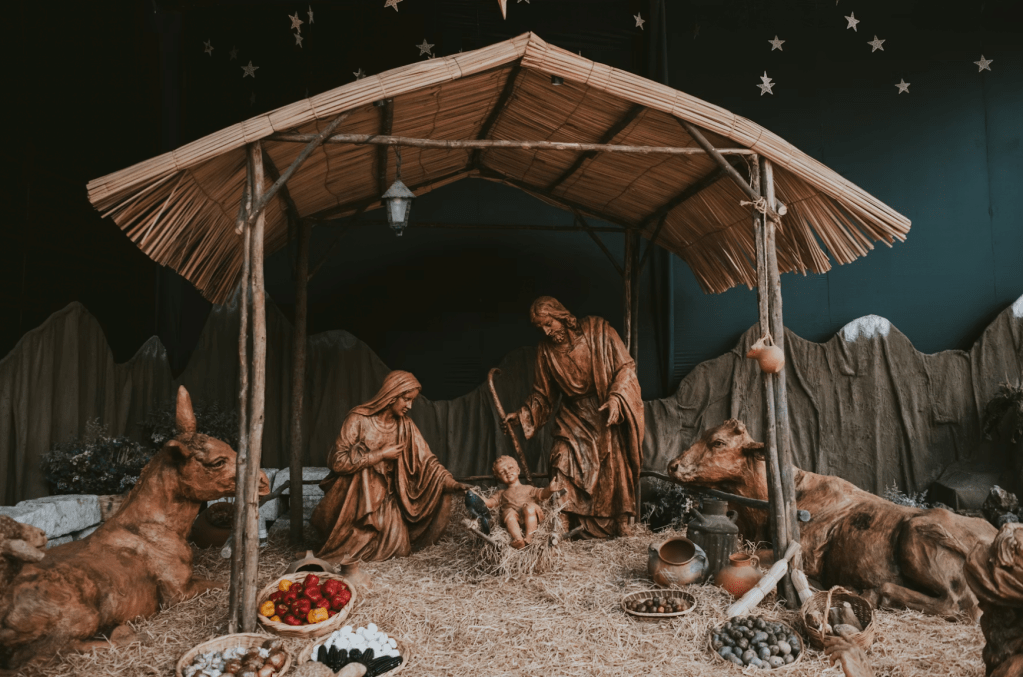
Away in a Manger, the well-loved Christmas carol, feels almost like a whisper to the listener, and this is by intention. It’s fundamentally a lullaby, evoking the intimacy of the Infant Christ Child with His Mother, Mary, at the beginning of salvation history through the power of the Incarnation.
The song stays very close to one, singular image, and this image, though simple, is rich with meaning: about the humility of God in coming not just in human form but in the form of a tiny infant, into a poor home, in vulnerable conditions.
You can listen to the Carol here:
This is my own recording of the carol above.
Lyrics
Away in a manger, no crib for a bed,
The little Lord Jesus laid down his sweet head.
The stars in the sky looked down where he lay,
The little Lord Jesus asleep in the hay.
The cattle are lowing, the baby awakes,
But little Lord Jesus no crying he makes.
I love Thee, Lord Jesus, look down from the sky
And stay by my cradle til morning is nigh.
Be near me, Lord Jesus, I ask Thee to stay
Close by me forever, and love me, I pray.
Bless all the dear children in thy tender care,
And take us to heaven, to live with Thee there.
With the opening lines, everything is set: we are given a kind of simple icon of Mary and Jesus, together in silence in a cold night thousands of years ago. And, beautifully, we step into the scene ourselves, but as little children going to the Child for comfort and peace. Even in His simplicity, we know He is God, and thus capable of tending to us, who remain vulnerable and small even as we grown into adulthood, ever recognizing our need for Him.
There’s no movement in the scene, and what you’re given is simple: a place, a child, a lack of comfort, and a pervading warmth of love.
A Humble Carol
Unlike many Christmas carols, this one doesn’t widen its scope, and doesn’t give itself to elaborate words or melodies, or the exuberance of many other carols, as lovely as those, too, are.
It doesn’t move to angels in the sky, or crowds of people, or larger theological implications or declarations. It allows the image itself to speak to the heart and bring us into a humble state of meditation of that great and holy night so long ago.
Instead, it stays with the Child, His immediate surroundings, and a quiet moment existing in the most profound love between mother and child that has ever existed or ever will exist.
Why It Feels Like a Lullaby
The carol feels like a lullaby because it is, in an interesting meta way: the carol is for us (sing by us or two us, especially as children), but ultimately it feels like us joining Mary in singing over the Infant Jesus.
It doesn’t push forward to some great height, but settles into the soul in a gentle and compelling way, focused on a few small details of the manger, the child resting, the animals around in the stable, and the general surrounding stillness.It’s thus associated often with children, quieter services, and more intimate Christmas settings where the more robust carols would potentially feel overwhelming. The structure of the song also supports this with its shorter lines, softer phrasing, and minimal shift in tone.
It doesn’t ask for attention but comes quietly to the listener, mimicking the quiet of that night in Bethlehem so long ago.
A Different Kind of Simplicity
There’s a risk with simple songs that they feel thin, but this one has a rich meaning behind its simplicity, despite not compete for attention through shifts in tone or narrative form or great melodic differentiation, and remaining a moment of contemplation throughout. In some ways, the more gently sung, the better.
The Question of Origins
This carol is often associated with children and sometimes mistakenly attributed to figures like Martin Luther, though that connection is not historically solid. What emerges to the surface is how it’s been used over time: often as a way to introduce children to the great mystery of the Incarnation in a way that inclines them to the Infant Christ Child’s side at this critical moment in history. Its traditional use at Christmastime yearly is a beautiful way that the meaning can grow over the years as children grow into adulthood, and we find ourselves understanding it only more, rather than leaving it behind with most of our other childhood reference points.
The simplicity of this carol is its gift and main strength, keeping it easy to warm to and pass on to other generations.
Ultimate Meaning
Away in a Manger is a quiet, focused Christmas carol that stays close to a single image of the Nativity, using simple language and steady tone to create a sense of stillness rather than expansion, and this allows it a timeless quality across all ages and generations.
 Catholic Kind: Catholic Music & Culture Resource