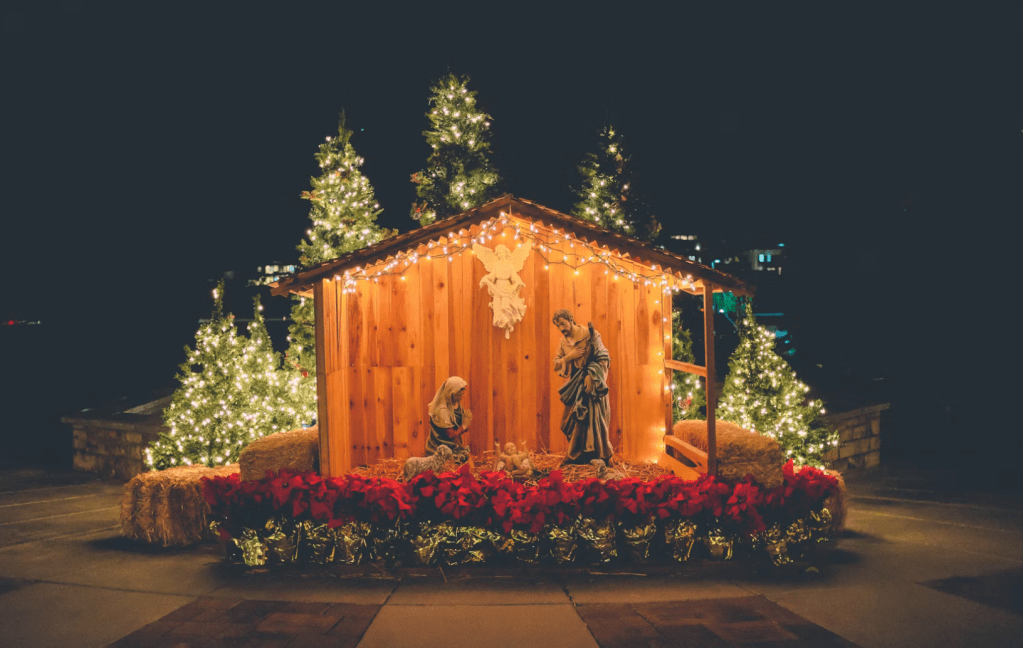
Traditional Christmas carols are among the most enduring songs ever written.
Long after most popular music has faded from memory, carols such as Silent Night, O Come, O Come, Emmanuel, Joy to the World, What Child Is This?, and Away in a Manger continue to be sung throughout the world. These beloved classic Christmas songs have survived across centuries, languages, and cultures, remaining a central part of the Christmas season for millions of people.
But why have these particular songs endured?
(This is my arrangement & recording of the classic Christmas song via my Catholic music project, Cassia & Myrrh.)
Part of the answer lies in tradition. Christmas carols connect us to family memories, church services, childhood experiences, and the rhythms of the liturgical year. Yet tradition alone cannot explain why some songs survive while others disappear.
The greatest Christmas carols speak to realities that never become outdated: longing, hope, wonder, humility, joy, and the search for meaning. Whether they tell the story of Christ’s birth, reflect on the mystery of the Incarnation, or celebrate the arrival of the Savior, these songs continue to resonate because they address questions and desires that remain deeply human.
In this article, we’ll explore some of these most beloved Christmas carols, their history and meaning, and the themes that have helped them endure for generations.
Why Some Songs Endure Across Generations
Every generation assumes its music will last.
Most of it doesn’t.
Songs that once dominated the radio, filled concert arenas, and seemed inseparable from a particular moment in history often disappear with surprising speed. A few survive; most fade. Even genuinely good music can find itself attached so strongly to a particular era that it becomes difficult to separate the song from the decade that produced it.
Yet every December, something strange and notable happens.
Songs written one hundred, two hundred, and sometimes even a thousand years ago return to public life as though they had never left.
People who rarely sing throughout the rest of the year suddenly find themselves singing. Children learn melodies their grandparents knew. Churches, schools, concert halls, and family gatherings fill with music that has crossed centuries almost unchanged.
Silent Night.
O Come, O Come, Emmanuel.
Joy to the World.
What Child Is This?
Angels We Have Heard on High.
Many of these songs are older than the countries in which they are sung! Some emerged from monasteries. Some began as hymns. Others developed out of folk traditions and local customs before spreading far beyond their original homes. Yet somehow they continue to endure.
It’s truly remarkable, when we zoom out and consider it.
There are few places left in modern culture where people still sing together in any meaningful way or stretch toward the kind of unity inherent in these songs. Music has become increasingly individualized: We listen through headphones, we stream playlists tailored specifically to our preferences, we consume music constantly, yet often in isolation.
Christmas carols belong to an older world, and they (wonderfully) assume something communal.
The images that come to mind may seem quaint, but they are powerful: people gathered around a piano; a church congregation singing together; families standing in candlelight on Christmas Eve; voices joining imperfectly but sincerely in songs that everyone already knows. And everything wrapped in the particular joy offered to all on Christmas.
Perhaps that is part of the reason these carols survive. They are not merely pieces of music; they are woven into rituals, memories, and traditions that are passed from one generation to another.
Nostalgia alone doesn’t explain their endurance.
If it did, countless other seasonal songs would enjoy the same longevity.
Instead, the greatest Christmas carols seem to possess a depth that allows them to remain meaningful long after the circumstances and time periods that produced them have changed. Beneath the melodies are themes that continue to resonate because they touch realities that never become outdated: longing, hope, wonder, humility, joy, love, and the search for meaning none of us can escape.
That may be why Christmas music often feels different from ordinary holiday music.
The best Christmas carols are not simply about winter, festivities, or seasonal cheer. They are rooted in a story that has shaped the imagination of entire civilizations. Whether one approaches them as expressions of Christian faith, works of poetry, or cultural treasures, they carry ideas that are larger than themselves.
Many of the most beloved carols are, in a sense, meditations put to music.
Some dwell on longing and expectation.
Some focus on the mystery of the Incarnation.
Some marvel at the humility of the Nativity.
Others erupt in celebration.
(This is my demo recording of the classic Christmas song via my Catholic music project, Cassia & Myrrh.)
Together they form something much richer than a playlist of seasonal favorites. They offer a window into the hopes, fears, questions, and convictions that generations of people have carried into the Christmas season.
That richness is one reason we all continue returning to them.
Musicans appreciate the craftsmanship. Listeners appreciate the beauty. But what is of most profound interest is the way these songs reveal different dimensions of Christmas itself. No single carol captures the whole story. Each illuminates a different aspect of it.
Some are filled with quiet reverence.
Others are triumphant.
Some ask questions.
Others proclaim answers.
Taken together, they form one of the most remarkable musical traditions in the Western world.
And perhaps that is why they continue to endure when so much other music fades.
They are not merely songs about Christmas.
They are songs about things human beings never stop searching for, and they offer a real and coherent possible answer to that search in the revealed mystery of Christ and His plan of salvation, begun on Christmas so long ago in Bethlehem.
Longing, Wonder, Humility, and Joy
One of the reasons Christmas carols remain so compelling is that they do not all approach Christmas from the same direction.
Modern Christmas music often compresses the season into a single emotional register. Everything is cheerful, festive, bright. It doesn’t leave much room for mystery, anguish, contemplation, and the true internal shifting of the human heart to which the season calls.
The older carols are much more patient.
They recognize that Christmas is not merely a celebration. It is the fulfillment of an ancient longing, shared in every human heart.
That is why some of the greatest Christmas music begins not with joy, but with waiting.
Consider O Come, O Come, Emmanuel.
Few Christmas hymns feel more different from the modern holiday atmosphere. The melody is restrained and the language is filled with yearning. Rather than celebrating what has already arrived, the hymn places us alongside those who are still waiting for redemption: all of human history, and especially the Chosen People, the Israelites of the Old Testament.
That longing gives the hymn much of its power.
For all the beauty of Christmas, most people know what it means to wait for something they do not yet possess. We wait for healing. We wait for reconciliation. We wait for answers. We wait for peace. The hymn understands that reality and gives voice to it before moving toward hope.
Something similar can be found in Of the Father’s Love Begotten, though in a different register. One of the oldest hymns still widely sung today, it approaches Christmas with a sense of reverence and awe. Rather than focusing primarily on Bethlehem, it reflects on the mystery of Christ’s eternal nature and His entrance into human history.
These are not songs of celebration alone. They are songs that recognize the depth of the longing that Christmas claims to answer.
Yet longing is only one part of the story.
Another is wonder.
If there is a question that echoes throughout many Christmas carols, it is a remarkably simple one:
Who is this mysterious Child?
That question lies at the heart of What Child Is This?
The hymn begins with an image that appears ordinary enough: a child resting in a manger. Yet every verse pushes beyond appearances, inviting the listener to consider who this child truly is and why His birth matters.
The same sense of wonder animates We Three Kings.
Part of the enduring appeal of that carol lies in its atmosphere of journey and mystery. Wise men travel from afar, guided by a star toward a destination they do not fully understand. The story has fascinated generations because it captures something deeply human: the desire to seek, to discover, and to follow truth wherever it leads and whatever it demands.
The best Christmas carols rarely eliminate mystery.
They preserve it.
They invite us to contemplate and enter into the mystery ourselves, rather than merely to consume.
Alongside longing and wonder stands another theme that appears repeatedly throughout the Christmas tradition: humility.
This may be the most surprising aspect of the Christmas story.
The central Figure arrives not in splendor, but in obscurity.
Not in a palace, but in a stable.
Not among the powerful, but among ordinary people.
Again and again, Christmas carols return to this paradox.
Silent Night does so through simplicity and stillness. The carol refuses spectacle. Its power comes from its restraint. It invites listeners into a scene marked not by grandeur, but by quietness.
Away in a Manger approaches the same mystery through the eyes of a child. Its enduring popularity comes partly from its gentleness. The hymn remains close to the Nativity itself, allowing the simplicity of the scene to speak for itself.
Likewise, Once in Royal David’s City highlights the contrast between earthly expectations of greatness and the humility of Christ’s birth. The carol reminds us that Christianity has always located divine significance in places the world might easily overlook.
Perhaps that is one reason these songs continue to resonate.
The world constantly encourages us to seek importance through visibility, status, and achievement. Christmas proposes something very different.
It suggests that greatness can appear in hiddenness, that love can reveal itself through humility, and that what seems small may, in fact, be world-changing.
Yet Christmas does not end in longing, wonder, or humility alone.
It ultimately arrives at joy.
That is where many of the most beloved carols find their culmination.
Joy to the World wastes no time in getting there. The opening declaration feels almost like a trumpet blast: The Lord has come!
The response is immediate: the earth is invited and even compelled to receive its rightful King.
The hymn possesses a confidence that has helped it endure for centuries. It does not speculate but confidently proclaims.
Similarly, Angels We Have Heard on High and O Come, All Ye Faithful embody a spirit of celebration that has become inseparable from Christmas itself. These are songs meant to be sung together, with melodies that lift upward and language that expands outward. They invite participation rather than observation.
And perhaps that is fitting.
Because Christmas, at its heart, is not merely a story to be analyzed.
It is an announcement of the greatest joy possible for mankind.
The great Christmas carols understand this.
Some approach it through longing.
Some through wonder.
Some through humility.
Some through joy.
Together they reveal why the tradition is so rich and why these songs continue to speak across generations.
Why Christmas Carols Survive When Most Music Doesn’t
The more time we spend with these song, the more we find ourselves returning to a simple question:
Why these?
Why have these particular carols endured while so much other music has disappeared?
Not every Christmas song survives. In fact, most don’t.
Every generation produces seasonal music. Some of it becomes briefly popular. A handful remain associated with a particular decade. Most eventually fade into the background as tastes change and audiences move on.
Yet Silent Night continues to be sung.
So does O Come, O Come, Emmanuel.
So do Joy to the World, What Child Is This?, Away in a Manger, and many others.
Part of the answer is undoubtedly tradition. Once a song becomes woven into family memories and cultural practices, it gains a certain resilience. Parents teach it to children, schools perform it, and churches sing it. The song becomes attached to Christmas itself.
But that explanation only goes so far.
Plenty of traditions disappear when they no longer feel meaningful. The fact that these songs continue to be sung suggests that they offer something people still find valuable.
Beauty balanced with singable simplicity is a critical part of the answer.
Like all great hymns, the great Christmas carols are remarkably well crafted. Their melodies tend to be memorable without being simplistic. Their texts often balance accessibility with depth. They reward repeated listening because they contain more than can be absorbed in a single encounter.
There is a reason that accomplished musicians continue to record them, choirs continue to perform them, and listeners continue to return to them as to a dear old friend.
Beauty has a way of surviving trends.
A genuinely beautiful work can outlive the circumstances that produced it because it continues to speak to something permanent in human nature.
The carols also endure because they address questions that never really go away: we are always seeing how much we need a Savior.
Human beings continue to wrestle with suffering and search for meaning.
We continue to hope for redemption, peace, reconciliation, and love.
The language and cultural setting may change. The technology certainly changes. Yet the underlying questions remain remarkably stable.
They speak about hope in the midst of uncertainty, light in darkness, meaning in an often confusing and overwhelming world.
These highlight the possibility that history is moving toward something good rather than simply moving in circles.
Whether one agrees with the theological claims behind these songs or not, it is not difficult to understand why such themes continue to resonate.
There is another factor as well.
The best Christmas carols are not merely individual works, but belong to a rich tradition. Pulling out one is to pull out a rich chapter of history.
A listener who encounters O Come, O Come, Emmanuel is not hearing an isolated song. The hymn exists alongside hundreds of years of Christian worship, art, literature, and music. The same is true of Silent Night, What Child Is This?, and many of the other great carols.
Each song gains strength from belonging to something larger than itself.
This is why traditional Christmas music often feels different from contemporary popular music. Much modern music is built around the individual artist and their various personalities or persona. Christmas carols, by contrast, tend to point beyond themselves: we rarely even know who wrote them! They belong to communities, and even entire nations.
No one “owns” Silent Night in the way that a modern artist owns a contemporary song.
It has become part of a shared inheritance.
This is why these carols can feel simultaneously personal and communal, lending to even more staying power. They carry individual memories, yet they also connect us to countless others who have sung the same words before us.
We live in a time when many people feel increasingly disconnected from history, tradition, and one another. Christmas carols resist that fragmentation. They remind us that we are participating in something that did not begin with us and will likely continue long after we are gone.
That is a rare gift and is one of the deepest reasons these songs endure.
Long after fashions change, technologies evolve, and cultural trends come and go, human beings will still be searching for beauty, meaning, hope, and belonging.
The greatest Christmas carols continue to survive because they speak, in their own way, to all four.
Explore the Most Beloved Christmas Carols
The carols discussed above represent only a small portion of the broader Christmas tradition. Each approaches the mystery of Christmas from a different angle, emphasizing a different aspect of the story and inviting a different kind of reflection.
The articles below explore the lyrics, history, meaning, and enduring appeal of some of the most beloved Christmas carols ever written.
Christmas Carols and Hymns
Silent Night
A gentle and contemplative carol that has become one of the most widely sung Christmas songs in the world.
Veni, Veni, Emmanuel (O Come, O Come, Emmanuel)
An ancient Advent hymn of longing and hope that continues to resonate across generations.
Joy to the World
A triumphant hymn celebrating the coming of Christ and the joy that follows from it.
What Child Is This?
A beloved Christmas carol that explores the mystery of the child in the manger and why His birth matters.
Away in a Manger
A simple and enduring carol that has introduced countless children to the Nativity story in a humble lullaby form.
Angels We Have Heard on High
A joyful hymn inspired by the angelic proclamation of Christ’s birth.
O Come, All Ye Faithful
One of the great Christmas hymns of worship and celebration.
God Rest Ye Merry, Gentlemen
A traditional English carol that focuses on comfort, hope, and the good news of Christmas.
We Three Kings
A carol centered on the journey of the Magi to Bethlehem, and the symbolism of their gifts.
Once in Royal David’s City
A beloved narrative carol reflecting on the humility of Christ’s birth and childhood.
Of the Father’s Love Begotten
One of the oldest Christmas hymns still sung today, rich in theological depth and reverence.
The Huron Carol (“‘Twas in the Moon of Wintertime”)
A uniquely North American Christmas carol that adapts the Nativity story into an Indigenous cultural setting.
Puer Natus Est
A traditional Christmas chant celebrating the birth of Christ and the joy of the Nativity.
Christmas Music and Sacred Tradition
Together, these songs reveal the remarkable breadth of the Christmas tradition.
Some are ancient. Others are relatively recent. Some emerged from monasteries and churches; others grew from local customs and folk traditions. Yet all of them continue to point toward the same central reality: the birth of Christ and the hope associated with this incredible mystery.
They have survived not because they are old, but because they continue to speak to the deepest needs of the human heart.
They remind us that Christmas is about much more than the nostalgia we associate with American movie Christmas. Beneath the decorations, gatherings, and familiar customs lies a story that has inspired artists, musicians, poets, and ordinary families for centuries.
The great Christmas carols help keep that story alive.
For additional resources, recordings, lyrics, and reflections, visit the full Christmas Carol Collection, where you’ll find the growing catalogue of Christmas music featured on this site.
Whether you are discovering these songs for the first time or returning to them once again, I hope this collection helps deepen your appreciation for one of the richest and most enduring musical traditions in the Christian world.

