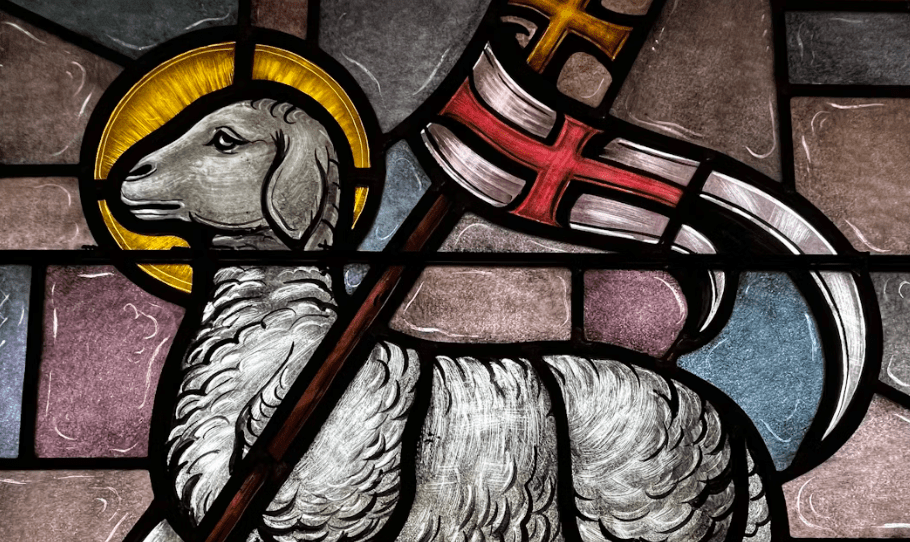
The Agnus Dei comes near the end of the Mass, just before Communion. By this point, everything essential has already taken place. The readings, Eucharistic Prayer, and consecration have all taken place.
What remains is for all of us to have the appropriate preparation to receive the God of the universe, miraculously made present in the Blessed Sacrament.
Listen to the Agnus Dei from the Missa de Angelis setting (Gregorian chant) here:
(This is my version of the Gregorian chant Ave Maria, and you can find my free full Gregorian chant album with PDF guide at the end of this article.)
Latin Text (Agnus Dei VIII)
Agnus Dei, qui tollis peccata mundi,
miserere nobis.
Agnus Dei, qui tollis peccata mundi,
miserere nobis.
Agnus Dei, qui tollis peccata mundi,
dona nobis pacem.
English Translation
Lamb of God, who takes away the sins of the world,
have mercy on us.
Lamb of God, who takes away the sins of the world,
have mercy on us.
Lamb of God, who takes away the sins of the world,
grant us peace.
What “Agnus Dei” Means
Agnus Dei translates directly as “Lamb of God.” The phrase is used in the New Testament to refer to Christ, especially in connection with sacrifice.
It draws on earlier imagery from the Passover of the Israelite people whose story we know from the Old Testament, where the lamb was central to the salvation of the people in the onslaught of the Angel of Death, and carries that meaning forward into the Mass in a deeper, eternal meaning proper to the Christian faith.
In this context, it is not abstract or symbolic, but specific and tied to what is happening at the altar: namely, the appearance of Christ as the sacrificial lamb to save us from the result of our sins.
Where the Agnus Dei Appears in the Mass
The Agnus Dei is sung during the breaking of the host, while all of the Mass participants are kneeling before this miraculous God. This action happens immediately before Communion, which gives the chant a very clear role.
The Church is preparing to receive Christ, and the prayer reflects that moment directly. It is not detached from the liturgy, but belongs to a specific action at a specific time.
Why the Prayer Is Repeated Three Times
The structure of the Agnus Dei is simple and consistent. The same line is sung three times, with a small change at the end. As is common throughout the Catholic liturgy, the repetition is intentional (as well as referential to the original sources), in order to heighten our awareness of what is being prayed and pull us out from our forgetfulness and human distraction.
The first two invocations end with miserere nobis — “have mercy on us.” The third ends with dona nobis pacem — “grant us peace.”
That shift matters, as the prayer moves us from asking for mercy to asking for peace with great confidence, like children. We go from pleading to a confident almost-command, rooted in our knowledge of His profound love for us.
The Missa de Angelis Setting
The Missa de Angelis setting is widely used because it balances clarity and beauty, although slightly more complex and “lifted” than the Jubilate Deo version. The melody is shaped enough to feel distinct, but not so elaborate that it becomes difficult to sing, and this is why it has become one of the most familiar and well-loved chants of the Church, often sung around the world by the laity, regardless of technical musical skill.
What the Agnus Dei Is Doing
The Agnus Dei does not explain what is happening in the Mass. It does not interpret it. It simply names Christ clearly as the fulfillment of the sacrificial lamb, through His action of death and resurrection millennia ago, and asks for what is needed: mercy and peace.
That simplicity is part of why it works so well at this point in the liturgy.
In summary, the Agnus Dei is the Church’s final preparation before Communion, allowing each person to encounter Christ anew as our Savior.
 Catholic Kind: Catholic Music & Culture Resource