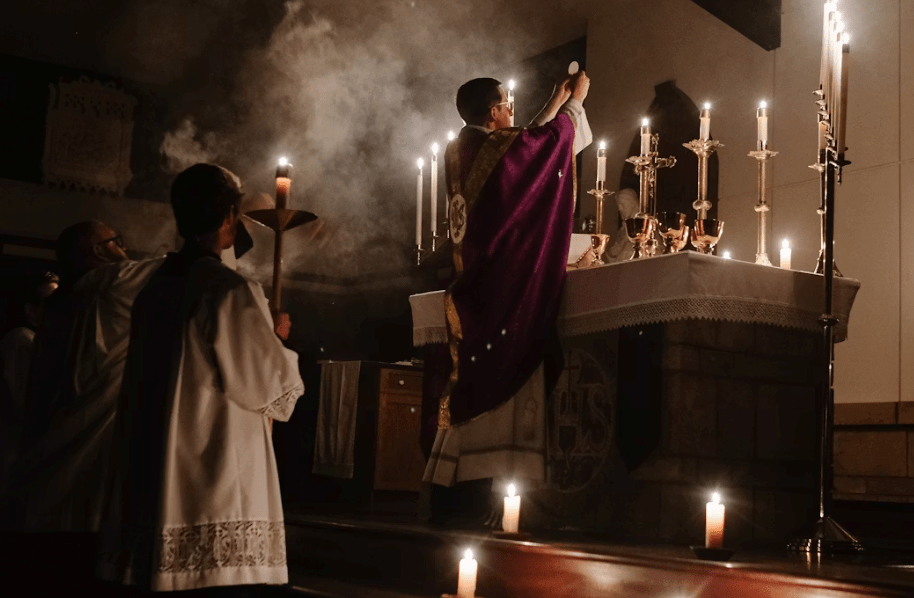
The Agnus Dei is sung near the end of the Mass, just before Communion. By then, the liturgy has already moved through the readings, the offering, and the Eucharistic Prayer. The central action has taken place.
Now the Church, God’s people in attendance at the Mass, turns toward receiving the incarnated God in the Eucharist.
Listen to the Jubilate Deo Gregorian chant version of the prayer here:
(This is my version of the Gregorian chant Ave Maria, and you can find my free full Gregorian chant album with PDF guide at the end of this article.)
Latin Text
Agnus Dei, qui tollis peccata mundi,
miserere nobis.
Agnus Dei, qui tollis peccata mundi,
miserere nobis.
Agnus Dei, qui tollis peccata mundi,
dona nobis pacem.
English Translation
Lamb of God, who takes away the sins of the world,
have mercy on us.
Lamb of God, who takes away the sins of the world,
have mercy on us.
Lamb of God, who takes away the sins of the world,
grant us peace.
What “Agnus Dei” Means
Agnus Dei, as seen above in the translation, means “Lamb of God.” The title comes from the way Christ is named in the New Testament, especially in connection with sacrifice and redemption and the history of Israel’s sacrifice of the unspotted lamb, an instruction given by God for the redemption of the people. In light of the fulfillment in Christ, it becomes the type and preparation for the final act of redemption of Christ on the Cross.
It is not decorative language. It points directly to who Christ is and what He gives. In the Mass, that meaning is especially clear because the chant is sung just before we receive Communion, preparing our hearts appropriately for the profound and mysterious reality we are about to engage in.
Where the Agnus Dei Appears in the Mass
The Agnus Dei accompanies the breaking of the consecrated Host, making its placement very concrete and intentional. As with all of the carefully and providentially selected parts of the Mass, the words are not random or floating above the liturgy; they are tied intimately to an action happening at the altar at the hands and words of the priest.
This is part of what makes the prayer so direct, echoing the earlier words and repetition of the Kyrie Eleison.
The Church (with her specific people in attendance, as well as joined with Heaven) is not speaking about mercy in general.
It is asking the Lamb of God for mercy and peace at the moment when Communion is approaching, with an eye to the holy fear and reverence a participant should have in approaching the alter.
Why the Final Line Changes
The first two invocations end with “have mercy on us.” The final one changes to “grant us peace.”
That small shift matters, as the prayer moves from sincere pleading for mercy towards a confident declaration of hopeful peace from on high.
The Jubilate Deo Chant Setting
The Jubilate Deo Gregorian chant setting, recommended often by the Vatican for all of the faithful, keeps the Agnus Dei restrained and focused on the simplicity and tradition of the words. The melody does not dramatize the text, but allows the repetition to work naturally.
Why This Chant Endures
The Agnus Dei has lasted because it is rooted deeply in Scripture and tradition and intentionally denotes the typology inherent in the unity between the Old and New Testaments, where the same God has been present to His people, ultimately unveiling Himself as the spotless Lamb for the sake of all those who believe in Him and choose to love Him.
The chant in particular is exquisite, calling immediately to the mind the sacredness and holiness of God, especially as He has made Himself present in the Liutrgy.
It names Christ, asks for mercy, and ends with peace, inviting us into this effective prayer which conforms us, over time, to the heart of God and His will for us: eternal salvation.
 Catholic Kind: Catholic Music & Culture Resource