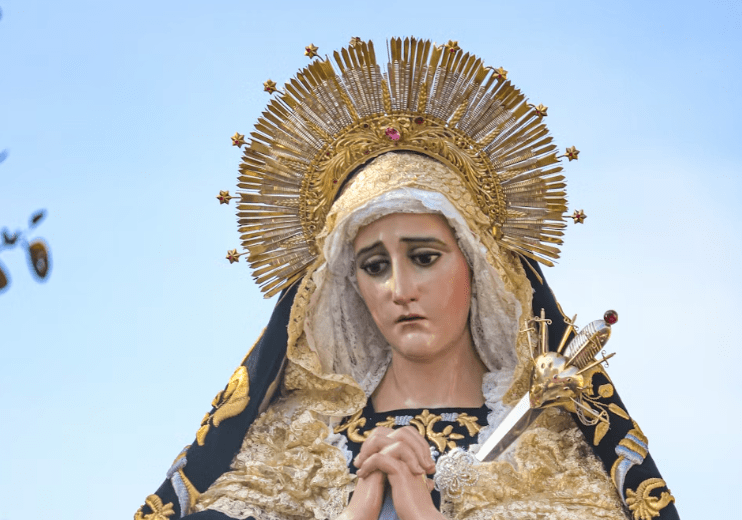
Stabat Mater (“At the cross Her station keeping”) is one of the most recognized Latin Gregorian chant hymns connected to the Passion and the specific season of penitence, Lent. It does not describe the events of the Crucifixion in a narrative way. Instead, it stays focused on a single image: Mary standing at the foot of the cross, and everything unfolds from that exquisite and haunting image.
Listen to the chant here:
(This is my version of the Gregorian chant Stabat Mater from my Cassia & Myrrh Catholic project, and you can find my free full Gregorian chant album with PDF guide at the end of this article.)
Latin Text (Opening Verses)
Stabat Mater dolorósa
Juxta Crucem lacrimósa,
Dum pendébat Filius.
Cujus ánimam geméntem,
Contristátam et doléntem,
Pertransivit gladius.
O quam tristis et afflicta
Fuit illa benedicta
Mater Unigéniti!
Quae mærébat, et dolébat,
Pia Mater, dum vidébat
Nati pœnas incliti.
Quis est homo, qui non fleret,
Matrem Christi si vidéret
In tanto supplicio?
Quis non posset contristári,
Christi Matrem contemplári
Doléntem cum Filio?
Pro peccátis suae gentis
Vidit Jesum in torméntis,
Et flagéllis súbditum.
Vidit suum dulcem natum
Moriéndo desolátum,
Dum emisit spíritum.
Eja mater, fons amóris,
Me sentíre vim dolóris
Fac, ut tecum lúgeam.
Fac, ut árdeat cor meum
In amándo Christum Deum,
Ut sibi compláceam.
Sancta Mater, istud agas
Crucifixi fige plagas
Cordi meo válide.
Tui nati vulneráti,
Tam dignáti pro me pati,
Pœnas mecum dívide.
Fac me tecum pie flere,
Crucifixo condolére,
Donec ego víxero.
Iuxta Crucem tecum stare,
Et me tibi sociáre
In planctu desídero.
Virgo vírginum præclára,
Mihi iam non sis amára:
Fac me tecum plángere.
Fac, ut portem Christi mortem,
Passiónis fac consórtem,
Et plagas recólere.
Fac me plagis vulnerári,
Fac me Cruce inebriári,
Et cruóre Fílii.
Flammis ne urar succénsus,
Per te, Virgo, sim defénsus
In die iudícii.
Christe, cum sit hinc exíre
Da per Matrem me veníre
Ad palmam victóriæ.
Quando corpus moriétur,
Fac, ut ánimæ donétur
Paradísi glória.
Amen. Allelúia.
English Translation
At the cross her station keeping,
Stood the mournful Mother weeping,
Close to Jesus to the last.
Through her heart, His sorrow sharing,
All His bitter anguish bearing,
Now at length the sword had passed.
Oh, how sad and sore distressed
Was that Mother highly blest,
Of the sole begotten One!
Christ above in torment hangs.
She beneath beholds the pangs
Of her dying glorious Son.
Is there one who would not weep,
Whelmed in miseries so deep,
Christ’s dear Mother to behold?
Can the human heart refrain
From partaking in her pain,
In that Mother’s pain untold?
Bruised, derided, cursed, defiled,
She beheld her tender Child,
All with bloody scourges rent.
For the sins of His own nation,
Saw Him hang in desolation
Till His spirit forth He sent.
O thou Mother: fount of love!
Touch my spirit from above,
Make my heart with thine accord.
Make me feel as thou hast felt;
Make my soul to glow and melt
With the love of Christ my Lord.
Holy Mother, pierce me through;
In my heart each wound renew
Of my Savior crucified.
Let me share with thee His pain,
Who for all my sins was slain,
Who for me in torment died.
Let me mingle tears with thee,
Mourning Him who mourned for me,
All the days that I may live.
By the Cross with thee to stay;
There with thee to weep and pray,
Is all I ask of thee to give.
Virgin of all virgins best,
Listen to my fond request:
Let me share thy grief divine.
Let me to my latest breath,
In my body bear the death
Of that dying Son of thine.
Wounded with His every wound,
Steep my soul till it hath swooned
In His very blood away.
Be to me, O Virgin, nigh,
Lest in flames I burn and die,
In His awful Judgment day.
Christ, when Thou shalt call me hence,
Be Thy Mother my defense,
Be Thy Cross my victory.
While my body here decays,
May my soul Thy goodness praise,
Safe in Paradise with Thee. Amen.
What “Stabat Mater” Means
The opening phrase Stabat Mater means “The Mother was standing,” which is a profound detail. The hymn does not begin with explanation so much as with presence of the Blessed Virgin Mary, courageously and humbly standing before Her Son as His most gruesome and humiliating moment, when He has been abandoned by the world.
Mary is there, at the cross, as the most important salvific moment in history unfolds, and Her presence there invites us, too, into contemplation of Christ in His passion as well as into a deeper conviction not to abandon Him in our lives.
Focus of the Hymn
The chant hymn proceeds in small, short stanzas, with each offering a new meditative concept or image as the song progresses. It remains fixed on the suffering of Christ throughout, seen always through the presence of His mother. It uses direct language, articulating the harsh reality of what Christ did for us in His passion, asking us to look at it soberly and, in that meditation, come to a deeper appreciation, gratitude, and sorrowful awareness of everything we believe in our faith.
Where the Hymn Is Used
Stabat Mater is most often associated with the Stations of the Cross, Good Friday, and general Lenten devotion, frequently used in parts rather than always sung in full.
The complete hymn contains many verses, beginning with description and gradually shifting toward personal prayer.
That movement is subtle. It does not feel like a clear transition, but over time the focus moves from observing Mary’s sorrow to asking to share in it.
What the Chant Does to the Text
The chant setting slows everything down, as is its particular gift, inviting us into a deeper place of contemplation aligned with many centuries of Christians before us. The lines are given space, which keeps the focus steady, calling us into a deeper engagement with the mysteries of Christ and our souls in relation to Him. This one in particular is gentle and repetitive such that the meaning of the phrases can wash over us like waves in the sea, immersing us in theological depth and a sense of the peaceful love of Christ, despite our sins and the suffering He endured for us.

