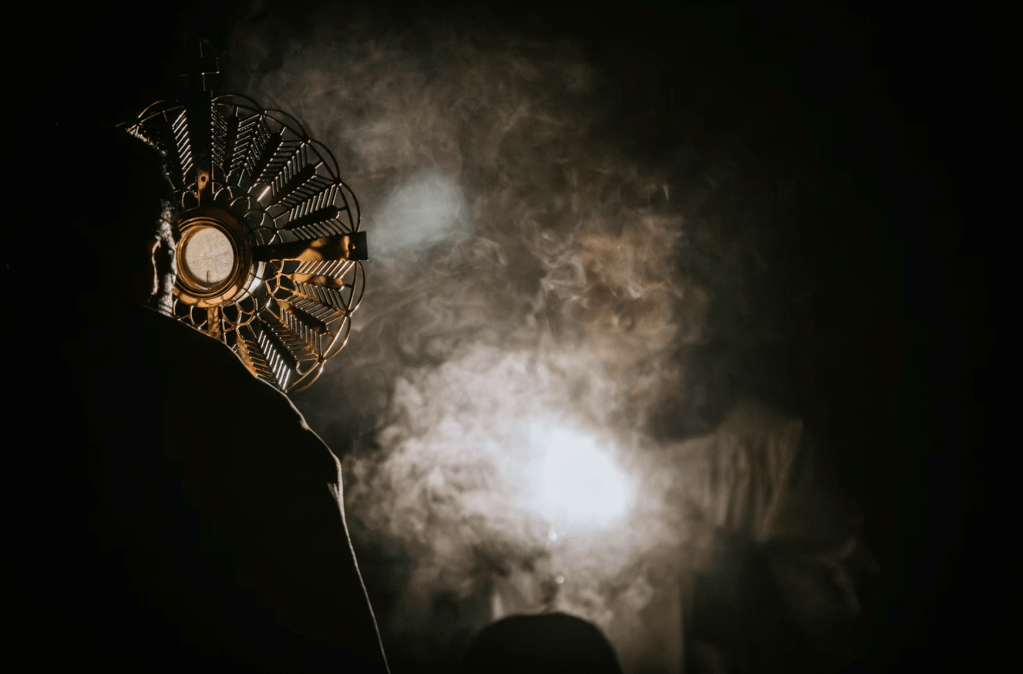
Pange Lingua is one of the most important Latin hymns connected to the Eucharist. It is longer than most Gregorian chants, and instead of repeating a short line as in many of the Mass parts, it unfolds in verses, offering a deepening meaning.
That structure gives it room to connect several parts of the Christian story into one continuous text.
Listen to the chant:
(This is my version of the Gregorian chant Pange Lingua from my Cassia & Myrrh Catholic project, and you can find my free full Gregorian chant album with PDF guide at the end of this article.)
Latin Text (Opening Verses)
Pange, lingua, gloriosi
Corporis mysterium,
Sanguinisque pretiosi,
quem in mundi pretium
fructus ventris generosi
Rex effudit gentium.
Nobis datus, nobis natus
ex intacta Virgine,
et in mundo conversatus,
sparso verbi semine,
sui moras incolatus
mira clausit ordine.
English Translation
Sing, O tongue, the mystery
of the glorious Body,
and of the precious Blood,
which, as the price of the world,
the fruit of a noble womb
the King of the nations poured forth.
Given to us, born for us
from an untouched Virgin,
and having lived in the world,
after sowing the seed of the word,
he brought the time of his dwelling
to a close in a wondrous manner.
What “Pange Lingua” Means
The opening phrase Pange, lingua means “Sing, O tongue.” The hymn begins by calling for expression—this is something meant to be spoken or sung, erupting into proclamation rathe than just interior prayer.
The focus is immediately on the Body and Blood of Christ, making the Eucharistic theme clear from the first lines.
Connection to the Eucharist
Although the hymn is often associated with Eucharistic devotion, it does not begin at the altar. It begins earlier, with the Incarnation.
This is important. The text connects Christ’s birth, life, and ultimate consummation of His love for us in the Eucharist.
Rather than treating them as separate ideas, it presents them as one continuous reality, united in the mystery of the Holy Trinity and God’s divine, providential plan to unite Himself with us for all of eternity, saving us from our sin and bringing us into the blessedness and joy of Heaven.
Who Wrote the Hymn
The hymn is traditionally attributed to Thomas Aquinas, and was composed for the Feast of Corpus Christi.
That context explains why the Eucharistic theme is so central.
Where “Pange Lingua” Is Used
This hymn is most often sung during Eucharistic processions, on Holy Thursday which especially points of the institution of the Blessed Sacrament, and for Corpus Christi, which especially celebrates the Body of Christ in a usually public, celebratory way.
The final verses are sometimes separated and sung as Tantum Ergo, especially during Benediction at the close of an Adoration Holy Hour.
What to Listen for in the Chant
The chant setting keeps the structure steady from verse to verse. This makes it easier to follow, even for someone unfamiliar with Latin, and it pulls the listener into the reverence and reflection and deep contemplation befitting something as remarkable as the sharing of Christ’s Body, Blood, Soul, and Divinity with us.
Pange Lingua is a Eucharistic hymn that connects the Body and Blood of Christ to the whole of His life, inviting us into an encounter with the living God and a heart filled with gratitude for all He has done for.

