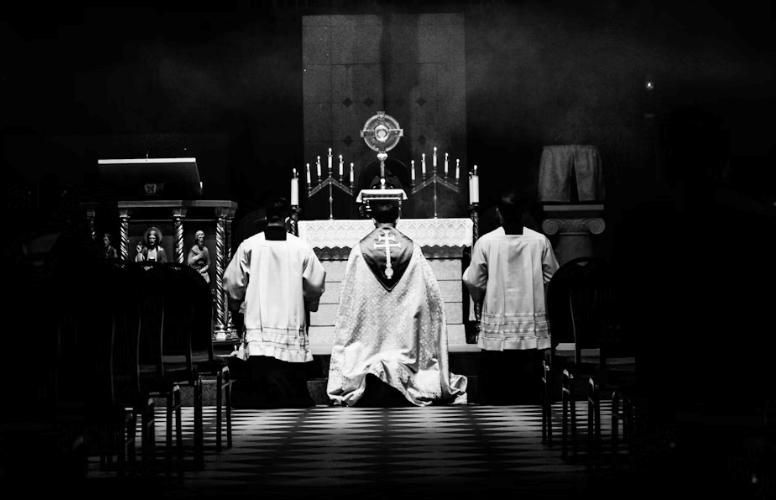
Mortem Tuam is a short text, but it sits in one of the most important places in the Mass. It is part of the Memorial Acclamation, which comes immediately after the consecration.
Because of that, the meaning is tied less to length and more to placement.
Listen to the Gregorian chant version of it here:
(This is my version of the Gregorian chant Ave Maria from my Cassia & Myrrh Catholic project, and you can find my free full Gregorian chant album with PDF guide at the end of this article.)
Latin Text
Mortem tuam annuntiamus, Domine,
et tuam resurrectionem confitemur,
donec venias.
English Translation
We proclaim your death, O Lord,
and profess your resurrection,
until you come again.
Where “Mortem Tuam” Appears in the Mass
This text is used as a Memorial Acclamation, spoken or sung directly after the consecration during the Eucharistic Prayer.
That placement is essential.
The bread and wine have just been consecrated. The Church has entered into the central mystery of the Mass. The response is not to explain what has happened, but to proclaim it.
That is what Mortem Tuam does.
What the Words Are Saying
The structure of the text is very clear:
- Mortem tuam annuntiamus — we proclaim your death
- et tuam resurrectionem confitemur — and profess your resurrection
- donec venias — until you come again
There is no expansion beyond this. It names the core of Christian belief directly, simply, and beautifully, recognizing that neither part makes sense without the others. The Gospel must be taken as a whole.
Why the Text Is So Short
Unlike longer prayers such as the Credo, this acclamation does not develop its meaning over multiple lines, as it does not need to. It is meant to be a simple summation of the truth.
Everything around it—the Eucharistic Prayer, the consecration, the liturgical context—already provides the depth. The acclamation responds by stating the essential points as clearly as possible.
That brevity is intentional.
How Chant Changes the Text
Because the text is short, the chant setting gives it space. The words are held slightly longer than they would be if simply spoken, allowing the resonance of this truth to fill the heart and mind.
This changes how they are heard. Instead of passing quickly, each phrase is allowed to stand on its own.
The chant does not add new ideas. It simply allows the existing ones to settle more deeply into the being of the singer or listener.
What “Mortem Tuam” Is Doing
This is not primarily a reflective prayer, but a proclamation.
The Church is not asking for something here. It is stating what is true: Christ has died, Christ is risen, and Christ will come again.
That forward movement—donec venias, “until you come”—is important. The text does not remain in the past but points ahead to the fulfillment of all of our desires in the return of our King, who will welcome us into eternity with Him.
 Catholic Kind: Catholic Music & Culture Resource