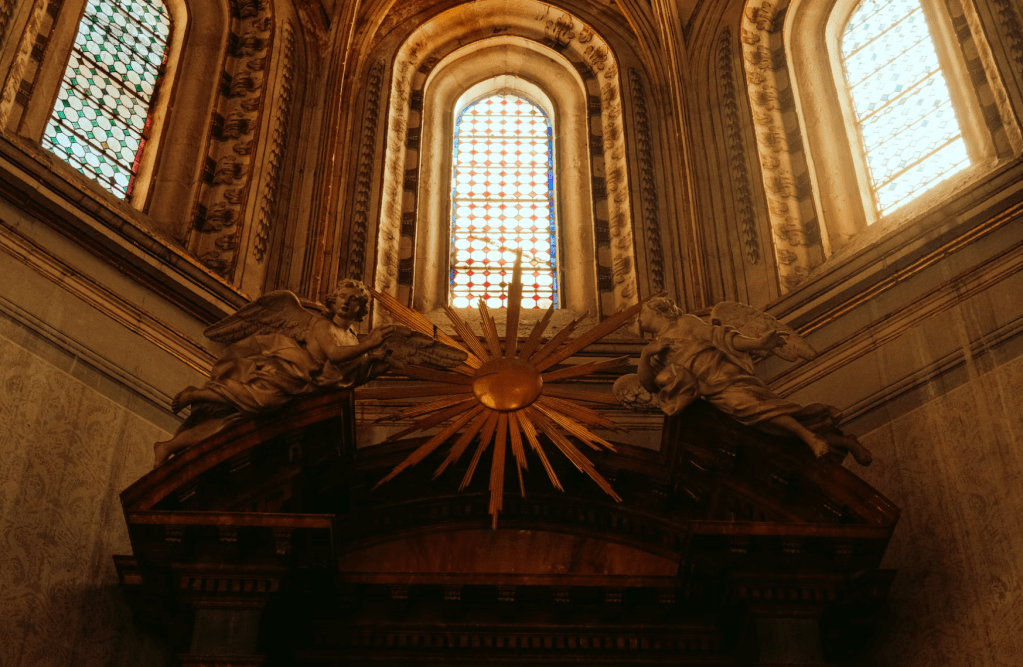
The Gloria is pure praise, and one of the oldest and most expansive hymns in the Catholic liturgy, featuring in most particularly celebratory Masses, including feast days and Sunday Masses. In the Gregorian Chant version in Missa de Angelis (Mass VIII), it’s set in a way that’s both accessible and enduringly beautiful, like so much of the rich history of Gregorian chant throughout the centuries of its existence and prayerful use. It comes out largely from the tradition of the monastics.
Listen to the chant here:
(This is my version of the Gregorian chant Ave Maria, and you can find my free full Gregorian chant album with PDF guide at the end of this article.)
Latin Text (Opening)
Gloria in excelsis Deo,
et in terra pax hominibus bonae voluntatis.
Laudamus te, benedicimus te,
adoramus te, glorificamus te…
English Translation (Opening)
Glory to God in the highest,
and on earth peace to people of good will.
We praise you, we bless you,
we adore you, we glorify you…
Meaning and Context
The Gloria begins with the words of the angels at Christ’s birth. From there, it unfolds into a sustained act of praise—naming God, addressing Christ directly, and ending in a Trinitarian structure.
Liturgically, it appears on Sundays and feast days (outside of penitential seasons like Advent and Lent), aiding all participants in the Mass to enter into the ancient shared tradition of praise of the Holy Trinity, and particularly for God’s gift of Himself in the Person of Christ via the Incarnation. Its absence during the penitential seasons makes its return more meaningful and noticeable; along with common other kinds of fasting, we fast from the unguarded joy toward God as a kind of accompanied penance, so we can enter more deeply into this marvelous truth of who God is, how He loves us, and how we can become a part of His heavenly plan of joy for all of us.
In the Missa de Angelis, the setting is melodic but not overly complex, which makes it perfect for more common and regular use, which is likely why it has become the most familiar chant version of the Gloria. It allows real participation, which is part of why it has remained so widely used, and why it is returned to in every generation, regardless of how many centuries pass.
There’s a specific kind of clarity to it, where in a way it instructs us to not yet focus on our prayers of petition until after its completion. As in so many guides for prayer, the Gloria teaches us, in the context of the great prayer of the Church in Mass, that first comes praise. And this praise carries great power, leading all the way to the throne of God in Heaven.

