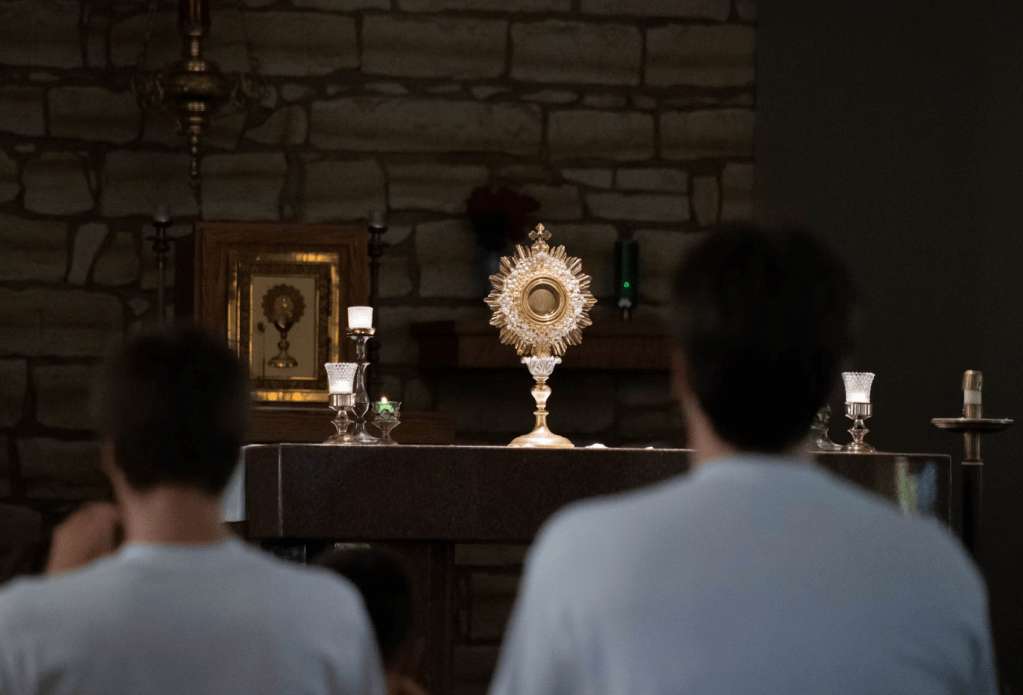
O Salutaris Hostia is a short Eucharistic hymn, but one of most widely used, along with Pange Lingua. It is often sung during Eucharistic adoration, and it comes from a larger hymn, Verbum Supernum.
Even though it is brief, it carries a very specific meaning tied to the Eucharist.
Listen to the chant here:
(This is my version of the Gregorian chant O Salutaris from my Cassia & Myrrh Catholic project, and you can find my free full Gregorian chant album with PDF guide at the end of this article.)
Latin Text (Full Hymn)
O salutaris Hostia,
quae caeli pandis ostium:
bella premunt hostilia,
da robur, fer auxilium.
Uni trinoque Domino
sit sempiterna gloria,
qui vitam sine termino
nobis donet in patria. Amen.
English Translation
O saving Victim,
who opens the gate of heaven:
hostile wars press upon us,
give strength, bring help.
To the One and Threefold Lord
be everlasting glory,
who gives life without end
to us in our homeland. Amen.
What “O Salutaris Hostia” Means
The phrase O salutaris Hostia translates as “O saving Victim.” The word hostia refers to a sacrificial offering, which connects directly to the Eucharist.
From the first line, the hymn is addressing Christ in His sacrificial role.
Connection to the Eucharist
This hymn is closely tied to Eucharistic devotion. The “saving Victim” is understood in the context of Christ’s sacrifice, made present in the Mass and adored in the Blessed Sacrament.
The second line—quae caeli pandis ostium (“who opens the gate of heaven”)—makes that connection even clearer. The Eucharist is not treated as symbolic here. It is described as something that opens access to heaven.
Where the Hymn Is Used
O Salutaris Hostia is most commonly sung during Eucharistic adoration, at Benediction, and sometimes during Mass in Eucharistic contexts.
Because it is short, it is often paired with Tantum Ergo, which comes from the end of Pange Lingua.
Meaning of the Middle Lines
The line bella premunt hostilia translates roughly as “hostile wars press upon us.” This is not limited to physical conflict. It can also be understood more broadly as struggle or opposition.
The response is direct:
- da robur — give strength
- fer auxilium — bring help
The hymn does not expand on the difficulty but humbly requests the graces needed to navigate the challenges of life, and especially the spiritual life.
The Closing Doxology
The final lines shift slightly:
Uni trinoque Domino sit sempiterna gloria — “To the One and Threefold Lord be everlasting glory.”
This is a standard form of praise directed to the Trinity.
The final line looks forward: qui vitam sine termino nobis donet in patria — “who gives life without end to us in our homeland.”
The “homeland” here refers to heaven.
Why the Hymn Works So Well in Chant
Because the text is short, the chant gives it extra space where the words can settle into the heart, mind, and soul.

