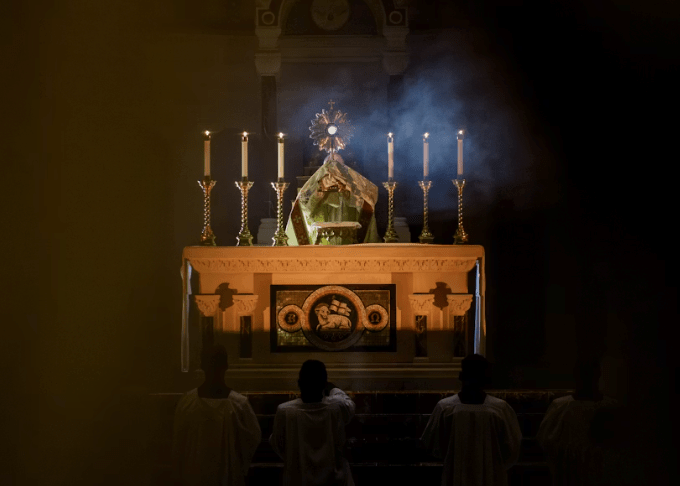
Let All Mortal Flesh Keep Silence feels different from most hymns immediately, offering a startlingly haunting melodic line honoring the reality of the mystery of the Incarnation.
This haunting sound sets the tone for everything that follows.
Listen to the hymn here:
(This is my version of the hymn from my Cassia & Myrrh Catholic project. You can find my free full Gregorian chant and hymns albums with PDF guides at the end of this article.)
Lyrics (Common Version)
Let all mortal flesh keep silence,
and with fear and trembling stand;
ponder nothing earthly-minded,
for with blessing in His hand,
Christ our God to earth descendeth,
our full homage to demand.
King of kings, yet born of Mary,
as of old on earth He stood,
Lord of lords, in human vesture,
in the Body and the Blood;
He will give to all the faithful
His own self for heav’nly food.
Rank on rank the host of heaven
spreads its vanguard on the way,
as the Light of light descendeth
from the realms of endless day,
that the powers of hell may vanish
as the darkness clears away.
At His feet the six-winged seraph,
cherubim with sleepless eye,
veil their faces to the Presence,
as with ceaseless voice they cry:
Alleluia, alleluia,
alleluia, Lord Most High.
What the Hymn Is About
The opening line is the key: “Let all mortal flesh keep silence.”
This is not just poetic language, but a sober instruction. The hymn begins by asking for stillness—specifically, a kind of stillness that sets aside distraction and ordinary thinking in order ro allow the mystery of the Incarnation to permeate our consciousness.
It doesn’t build excitement but commands the quiet and stillness appropriate to the weight of the theological truth being communicated.
Connection to the Eucharist
The hymn is often associated with the Eucharist, and that connection shapes how it is heard.
The line “Christ our God to earth descendeth” points to something happening—not just remembered, but present. The second verse makes that clearer: “He will give to all the faithful His own self for heav’nly food.”
The focus is not symbolic but direct: Christ reflects His coming in history with His coming at every Mass in the Eucharist, and truly desires to gives Himself to us fully in the mysterious and unbelievable way.
Tone of Reverence
There is a noticeable restraint in the language: silence, fear and trembling, veiling, stillness.
These are not common themes in modern hymns, which often move toward expression and energy. This hymn, even in contrast to other classic hymns, does the opposite.
It reduces movement rather than increasing it, calling us into a contemplative space rather than an exuberant way. Interestingly, it is also aligned with Christmas themes, and that contrast with triumphant joyfulness becomes especially stark when that is kept in mind.
Imagery from Scripture
The later verses introduce imagery drawn from Scripture:
- “host of heaven”
- “Light of light”
- “seraph” and “cherubim”
These references place the scene beyond the immediate setting of the Incarnation or the Mass, pointing instead to a much fuller meaning, drawing from the entire history of our faith, including its roots in the Old Testament.
What to Listen for
The melody typically follows the tone of the text—slow, steady, and restrained, calling attention constantly to the reverence due to the mystery being carefully articulated. There are no sudden shifts or dramatic movements.
Everything supports the sense of stillness that is required in this moment.
Let All Mortal Flesh Keep Silence is a hymn of reverence and stillness, centered on the presence of Christ, and expresseing through language the incomprehensible reality of God becoming man and then continually giving us to Himself, in every way possible, through the Eucharist at Mass.

