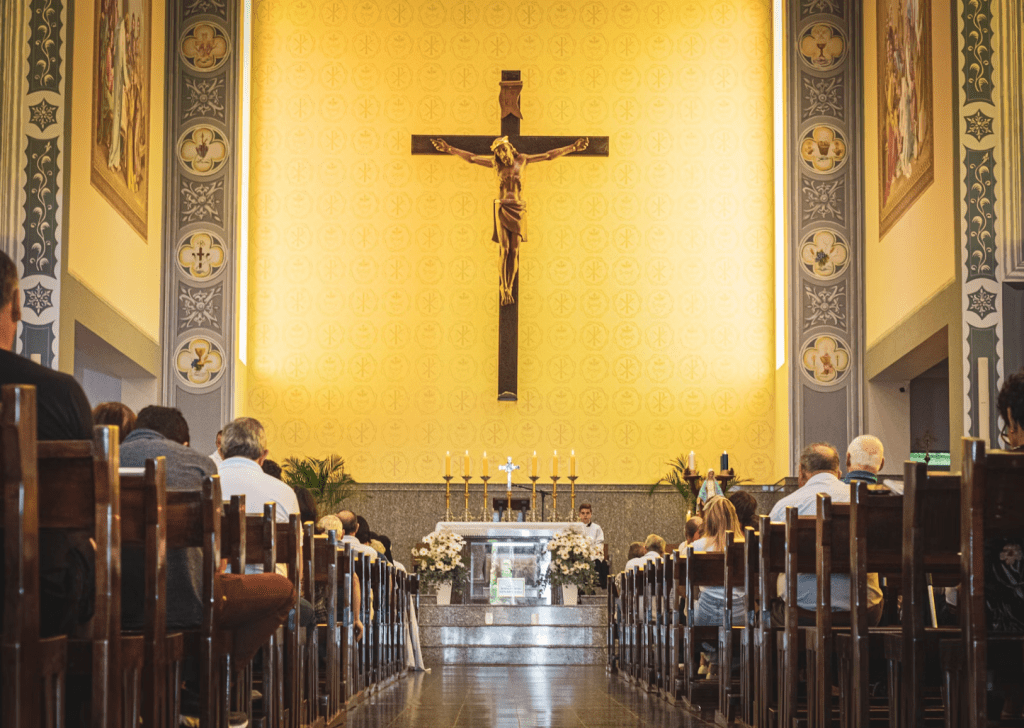
The Credo (the Creed and full statement of the definitive truths of our faith) is the point in the Mass where the entire summary of our faith is proudly and joyfully declared. Up to this moment, much has been heard—readings, a homily, prayers—but here, the response is clear and structured, rooted in the entire history of the Church, Christ’s teachings, the writings of Scripture, and the holy working out of clarity in the councils from the early centuries.
As a professor once noted, it is entirely inappropriate to de-emphasize the value of the Creed: people, many people given holy to Christ in the early Church, died that we could have this beautiful prayer acting as a north star for everything we live and do.
This is not a short or implied prayer, but a full declataion of all of the key fundamentals of our theology: our understanding of God, His salvific plan, who we are before Him, and the stark reality of death and eternal life.
Listen to the Gregorian chant version here:
(This is my version of the Gregorian chant Ave Maria, and you can find my free full Gregorian chant album with PDF guide at the end of this article.)
Latin Text (Credo III)
Credo in unum Deum, Patrem omnipotentem, factorem caeli et terrae, visibilium omnium et invisibilium.
Et in unum Dominum Iesum Christum, Filium Dei unigenitum, et ex Patre natum ante omnia saecula.
Deum de Deo, lumen de lumine, Deum verum de Deo vero, genitum, non factum, consubstantialem Patri: per quem omnia facta sunt.
Qui propter nos homines et propter nostram salutem descendit de caelis.
Et incarnatus est de Spiritu Sancto ex Maria Virgine, et homo factus est.
Crucifixus etiam pro nobis sub Pontio Pilato, passus et sepultus est, et resurrexit tertia die, secundum Scripturas.
Et ascendit in caelum, sedet ad dexteram Patris.
Et iterum venturus est cum gloria iudicare vivos et mortuos, cuius regni non erit finis.
Et in Spiritum Sanctum, Dominum et vivificantem, qui ex Patre Filioque procedit.
Qui cum Patre et Filio simul adoratur et conglorificatur: qui locutus est per prophetas.
Et unam, sanctam, catholicam et apostolicam Ecclesiam.
Confiteor unum baptisma in remissionem peccatorum.
Et expecto resurrectionem mortuorum, et vitam venturi saeculi. Amen.
English Translation
I believe in one God, the Father almighty, maker of heaven and earth, of all things visible and invisible.
And in one Lord Jesus Christ, the only-begotten Son of God, born of the Father before all ages.
God from God, Light from Light, true God from true God, begotten, not made, consubstantial with the Father; through him all things were made.
For us men and for our salvation he came down from heaven.
And by the Holy Spirit was incarnate of the Virgin Mary, and became man.
For our sake he was crucified under Pontius Pilate, he suffered death and was buried, and rose again on the third day in accordance with the Scriptures.
He ascended into heaven and is seated at the right hand of the Father.
He will come again in glory to judge the living and the dead and his kingdom will have no end.
And in the Holy Spirit, the Lord, the giver of life, who proceeds from the Father and the Son.
With the Father and the Son he is adored and glorified, and has spoken through the prophets.
And in one, holy, catholic and apostolic Church.
I confess one Baptism for the forgiveness of sins
and I look forward to the resurrection of the dead and the life of the world to come. Amen.
What the Credo Is
The Credo is a profession of faith. It is not a summary or a simplified version of belief—it is the full statement, said as it has been handed down. It thus holds prominence of place in the Mass and is only sometimes shortened to the Apostles’ Creed in some jurisdictions (which still holds the seed form of all of the truths more elaborately explicated in the Nicene Creed).
Each line was carefully shaped, with dense language due to its intention of expressing the faith accurately and fully. It is not trying to be poetic or flexible but just clear.
Where the Credo Appears in the Mass
The Credo comes after the readings and the homily. Truth has been proclaimed, and now the Church responds, emphasizing the context in which that same homily and the previous readings should be understood; any understanding contrary to what we profess here does not fit, and it is a consistent reminder at every Mass.
Everyone says the same words, in the same order, without change, across time and geography. It’s incredible, and should be contemplated. This unity is extraordinary.
How to Listen to the Credo
If you are hearing it for the first time in Latin, it helps to follow the translation while listening, in order to stay oriented.
The Credo is meant to state clearly what is believed, and to do so in a way that can be shared—unchanged—across time.
 Catholic Kind: Catholic Music & Culture Resource